Microsoft, Anthropic, and who bears the AI buildout risk
Figures come from Anthropic’s S-1 (filed October 26, 2026), Bloomberg and newsletter coverage; derived numbers are marked where they appear. One more important thing: this is not investment advice. Not investment advice. Not investment advice.
Two headlines, one question
Picture a fast-growing shop that rents the space it expects to need for the next several years. The landlord takes the long lease and builds out. The shop expects more customers to cover the rent. Both are betting on growth, but the shop’s customers never signed a long-term contract.
If business falls short, customers can simply stop coming, while the shop may not be able to stop paying rent. The landlord carries risk too: rent on a lease counts only once the tenant actually pays.
Keep that picture in mind and look at the two pieces of news from Microsoft and Anthropic on October 26. When companies commit resources ahead of AI’s growth and demand falls short, who has room to adjust, and who has to keep paying?
That day Microsoft offered a voluntary exit to about 60,000 employees, and Anthropic filed an S-1 disclosing hundreds of billions of dollars in multi-year compute commitments. The two are not directly related, but when I saw both headlines together, one question came to mind right away. Companies are committing to compute years ahead, while much of their revenue depends on how much their customers, and ultimately their end users, use each month. If demand falls short, which costs can be adjusted? And who should absorb the losses that truly cannot?
Microsoft’s choice
Microsoft’s offer covers employees up to level 70 (VP), about 27% of a 223,000-person workforce, with standard severance and an exit date of December 31. The word that matters is eligible: 60,000 people can say yes, but I have no idea how many will actually take the offer. In April, Microsoft ran its first-ever buyout for roughly 8,750 long-tenured US staff, and more than 30% accepted. A few months later, in July, it laid off about 4,800 people anyway. This time, Bloomberg reports the company expects lower uptake, so actual departures may be a fraction of the headline.
At the same time, Microsoft guided September-quarter capital spending above $50 billion, against $34.9 billion of actual spending a year earlier. Workforce reductions and data-center investment are running side by side.
Cutting staff is not necessarily caused by heavy data-center investment. What the two moves share is a direction: a growing share of the budget goes into long-lived assets, and a shrinking share into people whose numbers can be revisited every quarter.
This is my own reading, not a strategy Microsoft has disclosed. I think Microsoft is optimizing a business that has already matured and defending its cloud franchise. You can see the same thing in the CTV industry, where everyone is trying to run the same business with fewer people. Anthropic, which comes next, is racing for compute for a business that barely existed two or three years ago. Same direction, different motives.
How real is Anthropic’s demand
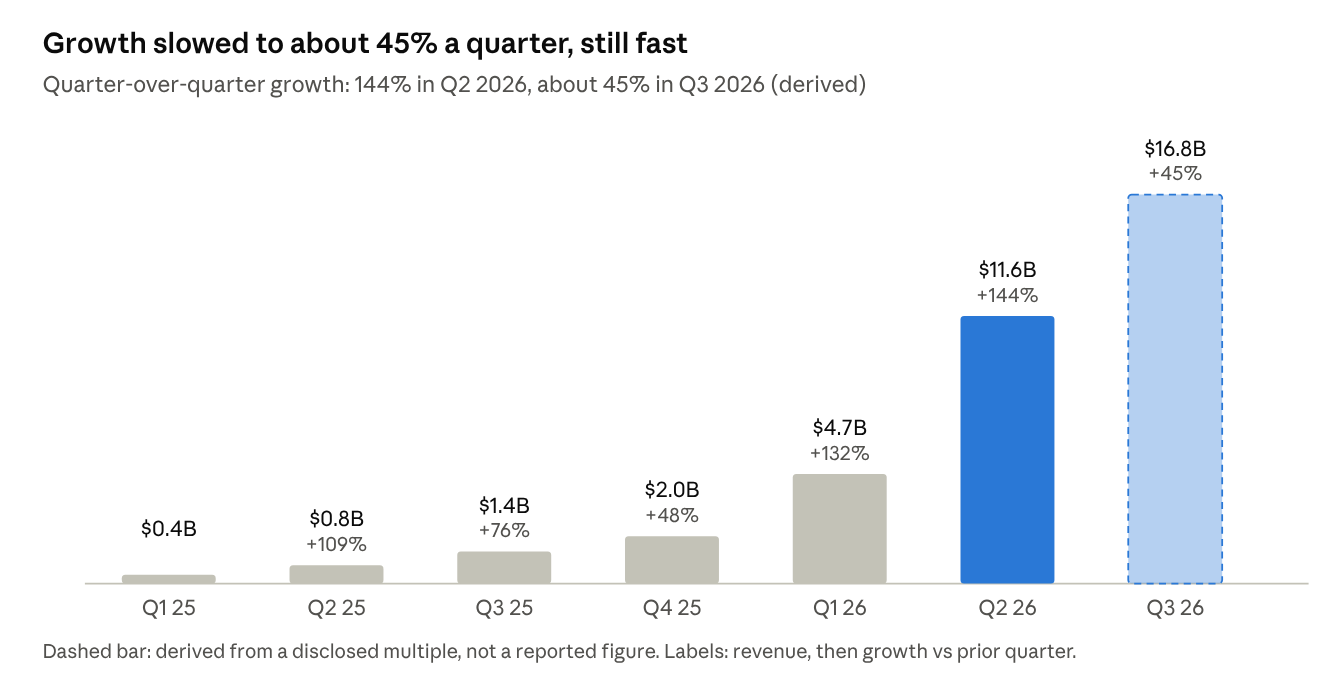
Anthropic S-1 and newsletter coverage · quarterly revenue, Q1 2025 to Q3 2026, $M · Q3 2026 derived
As the chart shows, the growth is real: revenue has grown 1.5x to 2.4x every quarter. Revenue more than doubled from Q1 to Q2 2026, and Q2 brought the first operating profit in the periods shown, $974 million. First-half operating cash flow was positive at $3.9 billion. The first-half net loss of $80.7 billion looks alarming until you see that $72.4 billion of it is non-cash fair-value changes on convertible notes and similar instruments, which rise as the company’s valuation rises.
The Q3 figure is not an actual reported number. It is derived from a multiple the filing discloses. If it holds, growth fell from about 144% a quarter to about 45%. That is a slowdown, not a decline: 45% a quarter is still extraordinary. The useful comparison is not growth against last quarter, but growth against the payment schedule in the next section.
On revenue quality, I think three things deserve particular attention:
-
Gross recognition. About 48% of first-half revenue came through cloud marketplaces. Under gross recognition the full sale is revenue and the partner’s cut is an expense, which follows a principal-versus-agent judgment. That is not inflation, but it makes revenue multiples hard to compare with companies that report net.
-
Policy enforcement. Newsletter coverage puts revenue from customers later found to violate usage policies at 5% to 7% of the first nine months. Tighter enforcement from August could leave a gap in Q4.
-
Retention. Net revenue retention of about 900% reflects a small base growing explosively. It will not repeat and should not be extrapolated.
Demand also looks broad: no customer exceeds 10% of revenue, and 79% of Q3 revenue came from outside the top five.
The duration gap
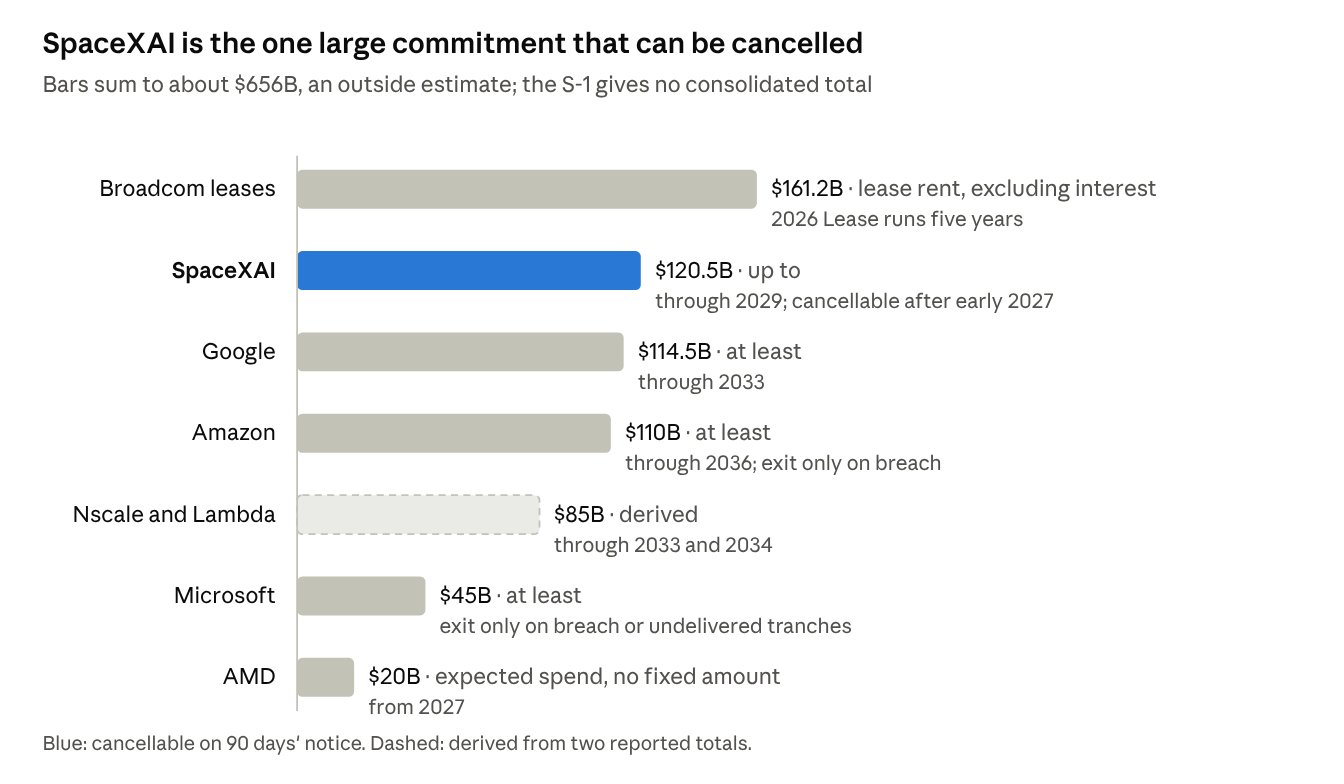
Anthropic S-1 as reported by Fortune, The Stack, Reuters and newsletters · $B · Nscale and Lambda derived
The S-1 does not add these up; its consolidated commitment table is still blank, and outside estimates range from about $518 billion to $808 billion depending on what is counted. Nor are the bars the same kind of promise. Amazon’s deal can be exited only if Amazon materially breaches. Microsoft’s is non-cancellable except for breach or undelivered tranches. SpaceXAI’s runs through 2029, but after non-cancellable periods ending in January or March 2027, either side can cancel on 90 days’ notice. AMD carries no fixed dollar amount, only an initial capacity commitment.
On the other side, about 80% of revenue is usage-based. Remaining performance obligations, the contracted revenue not yet recognized, were $10.8 billion at June 30, with about 75% expected to be recognized as revenue within twelve months. Next to multi-year commitments, that cover is pitifully small. It does not mean demand is weak, since usage revenue often never enters a contract. What it means is that the revenue side is less certain than the cost side.
How large is the gap year by year? The filing has no schedule, so the chart below spreads each commitment evenly over its known or assumed term.
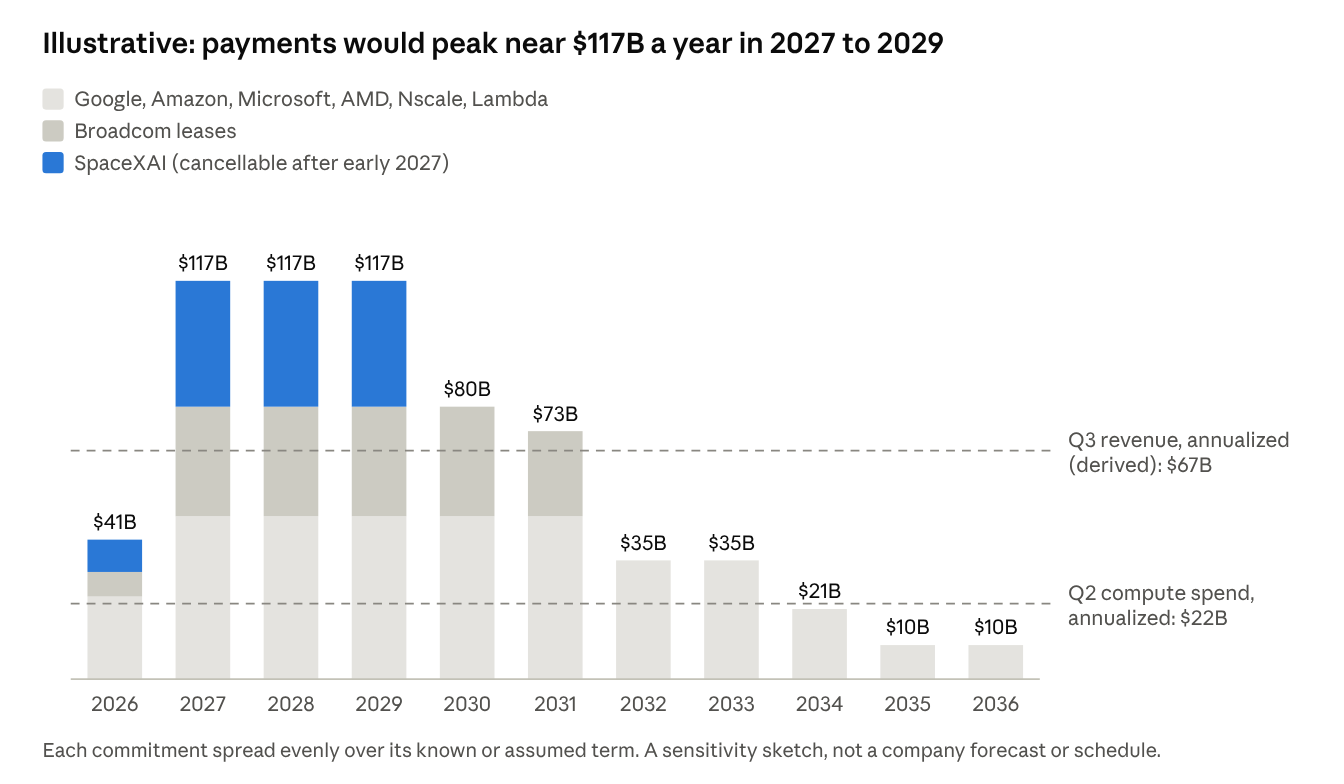
Author’s model from disclosed amounts · straight-line, some terms assumed · $B per year
Three readings, all conditional on that assumption:
-
The pressure, if any, sits in 2027 to 2029, when SpaceXAI and the Broadcom 2026 Lease overlap. Payments then would be roughly five times the current compute run rate.
-
SpaceXAI is the main lever. Cancelling it cuts those years to about $80 billion.
-
Revenue has to keep compounding. With flat revenue, 2027 payments would be 174% of revenue; with 50% annual growth, 116% in 2027 and 52% by 2029. Holding the first-half ratio, when revenue was about twice compute expense, would take roughly $234 billion of revenue a year.
The straight-line assumption is the weakest link. Capacity comes online in stages, so early years are probably lower and later years higher. One analyst reads the filing as placing substantially all remaining commitments in 2031 to 2045, which would push any squeeze out by years. Until an amended S-1 includes a payment schedule, treat the chart as a sensitivity, not a forecast.
Suppliers as financiers
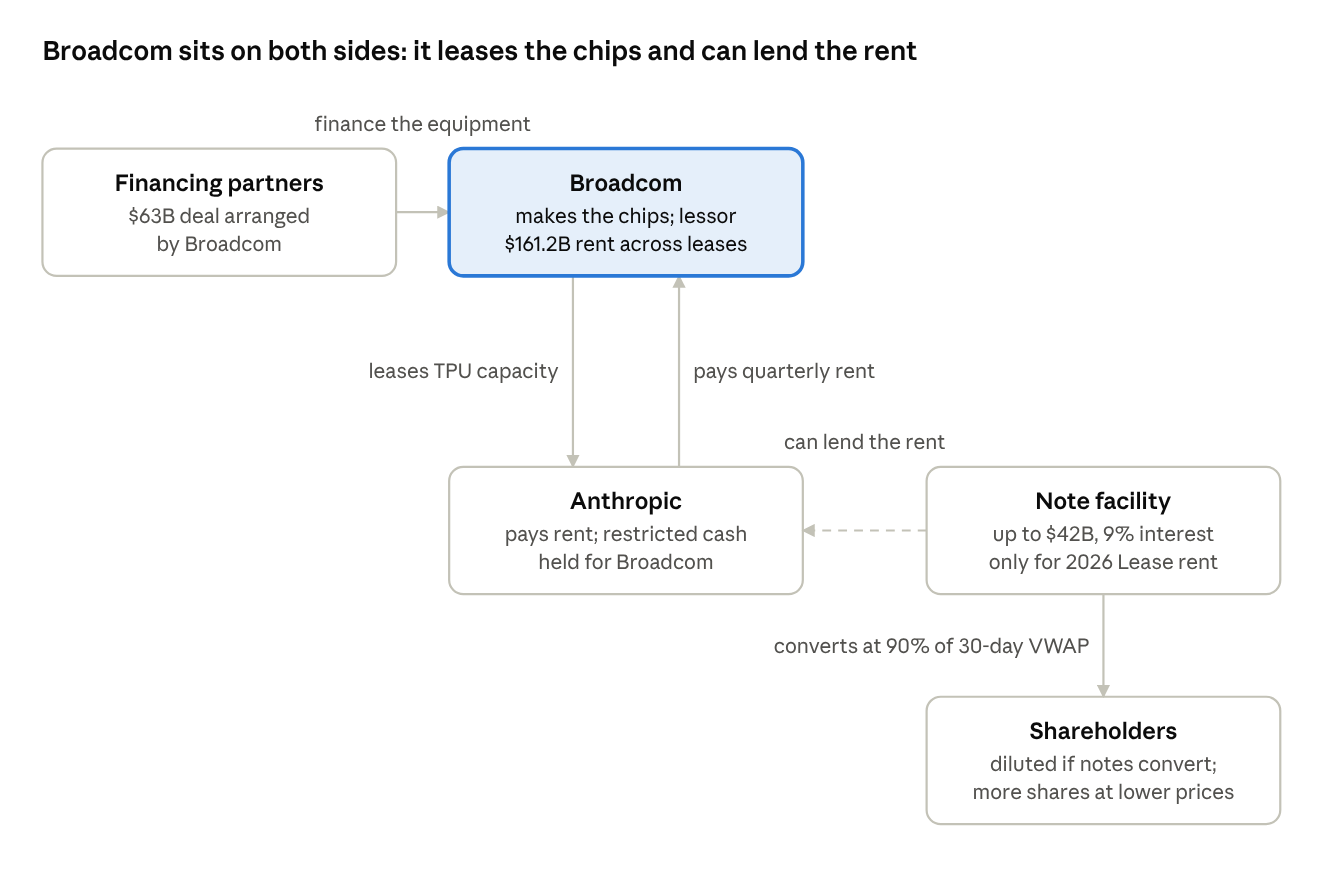
Broadcom arrangements as described in the S-1 and Reuters coverage · 5 parties
Broadcom is the clearest case of a supplier that is also a financier, and its numbers are easy to misread, so map them first. The $161.2 billion is total rent, excluding interest, across several Broadcom equipment leases. One of them, the 2026 Lease Arrangement, is about $125.2 billion over five years. Anthropic may finance part of that lease’s quarterly rent with convertible notes of up to $42 billion, and does not expect to issue any before the IPO. Separately, Broadcom has arranged a $63 billion deal to finance equipment delivery. These are different instruments with different payers. Adding them double-counts: if the notes pay the rent, the same dollars appear twice.
The note terms matter for shareholders. The notes carry 9% interest and, after listing, convert at 90% of the 30-day volume-weighted average price, with stricter terms (85% and a higher rate) for some notes if certain revenue conditions are missed. Because conversion is priced off the market, a lower share price means more shares issued. Anthropic has also deposited cash in a restricted account for Broadcom’s benefit and may have to add more. According to Reuters’ reading of the filing, certain payment or performance defaults could make a large part of the lease obligations immediately due while limiting access to the note facility.
None of this makes Broadcom a risk-free landlord. A supplier that also lends concentrates its exposure in one customer. Whether its losses would actually grow in a downturn depends on the use of funds, collateral, recourse and seniority, details that sit largely in redacted exhibits. What the structure does is spread utilization and asset risk across the model company, the equipment maker, the financing partners and, through conversion, Anthropic’s shareholders.
Put simply, retail investors who buy after the IPO end up partly “co-signing the lease,” and take on part of the risk. Their exposure is economic: fixed costs squeeze equity value if revenue disappoints, and financing on market-priced terms dilutes them further.
Nor is this unique to Anthropic. Nvidia has used its balance sheet to help customers buy its chips, and the pattern makes sense in a supply-constrained market. It also means a slowdown would not stay contained in one company.
What would prove the worry overdone
The case for calm is real. Anthropic held $131.7 billion in cash and short-term investments at June 30 and generated positive operating cash flow in the first half. Revenue in that period was about twice compute and infrastructure expense. That is a period ratio, not proof of returns on future capacity, but it is a better starting point than most expected. Demand is spread across many customers, and some of the largest commitments have flexibility built in: SpaceXAI can be cancelled after early 2027, and AMD has no fixed dollar amount.
So the useful question is not whether the headline total sounds large. It is which signals would show the gap closing:
-
Capacity utilization. Is new capacity used as it comes online, or does it sit idle?
-
Revenue per compute dollar. Does the first-half ratio hold as the big leases start, or slide toward one?
-
Ability to pay. Do operating cash flow and cash on hand cover the payment ramp without emergency financing?
-
Financing terms. Do later raises come on stable or worsening terms? A crowded equity window, with Meta reported to be raising up to $95 billion, may compete for the same capital, though that is background, not evidence about Anthropic’s terms.
What to watch next:
-
The amended S-1: price range, Q3 actuals and, ideally, a payment schedule.
-
Q4 revenue, including the effect of policy enforcement and pricing.
-
Hyperscaler capex guidance in the next round of earnings.
-
Microsoft’s actual buyout uptake in December.
Back to the opening story: companies are trading flexible costs for long-lived capacity. Whether that pays off depends on revenue that has not been earned yet. If it never arrives, small retail investors like me had better be careful.
Sources and method
Derived numbers (Q3 2026 revenue, the Nscale and Lambda commitment, the payment schedule) are the author’s calculations and are marked where they appear. Microsoft’s buyout details come from Bloomberg and newsletter coverage; no official Microsoft statement giving the 60,000 figure was located.
-
The Stack: Anthropic S-1 shows it is at the hyperscalers’ mercy
-
Reuters via The Star: Broadcom to lend Anthropic up to $42 billion
-
Decoding Discontinuity: the S-1 leaves its biggest bill blank